Islamic Cairo & Khan El Khalili: A Walking Route
Last Updated:
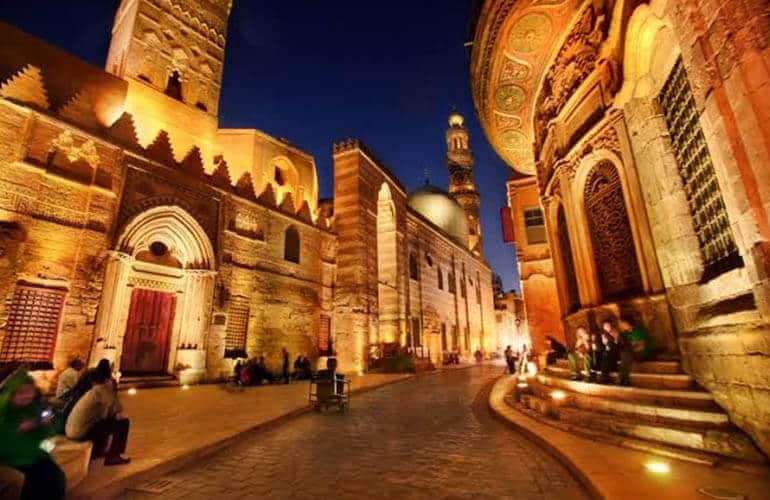
This is one of the oldest continuously inhabited urban areas on earth. The street you'll walk — Al-Muizz Li-Din Allah — has been a main thoroughfare since the 10th century. The architecture lining it represents nearly every Islamic dynasty that ever ruled Egypt: Fatimid, Ayyubid, Mamluk, Ottoman. The whole stretch is a UNESCO World Heritage Site.
Most people rush through it in two hours on a guided tour. This route is built for a half-day at minimum — with actual time to go inside things, sit down, get lost in the bazaar, and understand what you're looking at.
Before You Start: The Practical Setup
Best time to go: Start between 8:00–9:00 AM on any day except Friday. Friday mornings mean mosque closures and crowds around Al-Azhar during midday prayers. Weekday mornings are ideal — the street is quieter, light is better for photography, and the heat hasn't built up yet.
Getting there: Take an Uber or Careem to Bab al-Futuh (the northern gate) — it's the logical start of the route and most drivers know it. From Downtown Cairo it's about 15–20 minutes depending on traffic. Do not start from Khan El Khalili — you'll be walking the wrong direction and missing the best architecture.
What to wear: Covered shoulders and knees for the whole route. Not optional — you'll be entering active mosques. Women: bring a scarf or headcovering (available at mosque entrances, but easier to have your own). Comfortable walking shoes. This is old stone, uneven ground, and several staircases.
What to carry: Water, cash in small EGP notes (for entrance fees, tips, and street food), your phone with Google Maps downloaded offline. The route is mostly linear but the alleys around Khan El Khalili can disorient. Offline maps help.
Total distance: Approximately 1.5 km walking, plus whatever wandering you do in Khan El Khalili. Budget 4–5 hours for the full route.
The Route: North to South
Stop 1 — Bab al-Futuh (Start Here)
⏱ 8:30 AM | 20 minutes | Free
This is where you begin. Bab al-Futuh — Gate of Conquest — is one of three surviving gates from the original Fatimid city wall, built in 1087 AD. The gate is open 24 hours and free to enter. Walk through the arch and you're stepping into the core of medieval Islamic Cairo.
The tunnels inside the wall are worth a few minutes — the Arabic inscriptions and the sheer weight of the stonework give you an immediate sense of the scale of what Fatimid Cairo was. Stand at the top of the gate and look south: the entire length of Al-Muizz Street stretches out ahead of you.
Local note: The gate area is being periodically renovated. Some sections may be temporarily restricted. Walk through and get oriented — the street starts immediately on the south side.
Stop 2 — Al-Hakim Mosque
⏱ 8:50 AM | 25 minutes | Free
Directly south of Bab al-Futuh, on your left as you walk down Al-Muizz. Built by the Fatimid Caliph Al-Hakim bi-Amr Allah between 990–1013 AD, it's one of the oldest mosques in Cairo still in active use.
The interior is vast and largely stripped of ornament — which makes it more striking, not less. A huge open courtyard surrounded by white marble arcades, the proportions enormous. Most tourists walk past it on the way to flashier monuments further south. That's a mistake. Go inside.
Practical: You'll pass through an x-ray scanner at the entrance. Free entry. Dress code enforced at the door.
Stop 3 — The Qalawun Complex
⏱ 9:45 AM | 40 minutes | ~$3–5 USD
The architectural centerpiece of Al-Muizz Street and one of the most important Mamluk structures in the Islamic world. Built by Sultan Al-Mansur Qalawun between 1284–1285 AD, the complex contains a mosque, a madrasa (Islamic school), and a mausoleum — all in one interlocked building.
Buy your ticket from the booth directly across the street before entering. The ticket typically covers the complex plus several other monuments along the street (the Al-Nasir Muhammad Mosque complex and parts of the Barquq complex are sometimes bundled in). Ask at the ticket window exactly what's included.
What to prioritize inside:
- The mausoleum — the interior is one of the finest examples of Mamluk stucco and stone carving in Cairo. Geometric patterns, Arabic calligraphy, and colored marble at a level of detail that's genuinely staggering for something built in 1285.
- The madrasa facade on the street — look up at the entrance portal. The inlaid stone and carved woodwork is considered by many architectural historians to be among the earliest integration of Syrian Gothic influence into Islamic architecture.
Watch out for: Unofficial "guides" inside who will latch on and then request payment. They are not required and not official. A firm "no thank you" works.
Stop 4 — Khan El Khalili Bazaar
⏱ 10:45 AM | 60 minutes | Bring what you're comfortable spending
You've now arrived at Cairo's great medieval market, established in 1382 by Emir Djaharks el-Khalili as a caravanserai. The physical structure has been rebuilt multiple times but the market has operated continuously for over 600 years. It is touristy, deliberately confusing, and genuinely extraordinary.
How to actually experience it:
Walk past the main entrance alley — the one with the densest souvenir shops — and go deeper. Turn into side alleys. The market thins out and becomes more local. You'll find gold and silver workshops, spice sellers, fabric merchants, copper craftsmen, and shops that look as if they've been exactly the same for 80 years. Some have been.
What's worth buying:
- Papyrus — only if it's genuine (hold it up to the light; real papyrus has visible plant fibers, fake papyrus made from banana leaves is smooth). Quality papyrus is available here at better prices than at museum shops.
- Spices — the spice market section is excellent. Cumin, coriander, hibiscus (karkadeh), dried rose petals, and blended spice mixes specific to Egyptian cooking.
- Brass and copper items — hand-beaten lanterns, trays, and decorative plates. Prices vary enormously. Start negotiations at roughly 30–40% of the first quoted price.
- Handmade glass — Khan El Khalili has several workshops producing hand-blown glass in traditional Egyptian designs.
What's not worth your money: Mass-produced alabaster figurines, plastic Pharaonic statues, or anything labeled "genuine antique" near the main entrance. These are not antiques.
Stop 5 — El Fishawy Café (Break)
⏱ 11:45 AM | 30 minutes | ~$2–5 USD
Inside Khan El Khalili, down one of the narrow alleys running west off the main bazaar lane. El Fishawy has been open continuously since 1773 — it operated through the French occupation, the British occupation, and every other chapter of modern Egyptian history. Nobel Prize-winning author Naguib Mahfouz was a regular.
The tea is not Cairo's best tea. The prices are above average for the area. None of that matters. Sit down, order a mint tea or Turkish coffee, and let the city come to you. Vendors will attempt to sell you things at your table. A polite no is sufficient. Watch the alley. Listen to the noise. This is the correct thing to do for 30 minutes in the middle of this walk.
Honest note on ratings: El Fishawy gets mixed Google reviews — some visitors find it overpriced and chaotic. They're not wrong. But context matters: this isn't a restaurant you visit for the quality of the beverage. It's a place with 250 years of continuous operation in the middle of one of the world's oldest markets. Adjust expectations accordingly.
Stop 6 — Al-Azhar Mosque
⏱ 12:15 PM | 35 minutes | Free
Cross Al-Muizz Street heading east — Al-Azhar is a short walk from Khan El Khalili, essentially adjacent. Founded in 970 AD, Al-Azhar is simultaneously one of the world's oldest universities (still in operation), the most significant Sunni Islamic institution on earth, and an active working mosque visited by thousands daily.
The forecourt and main prayer hall are open to non-Muslim visitors outside prayer times. You'll enter through a side entrance and pass through security. Robes are provided for women who need them at the entrance.
What you're looking at: Five minarets in different styles representing different eras of construction — the oldest 14th century, the newest 18th century. The main courtyard is marble and arcaded, relatively calm even when the surrounding streets are at full chaos. Students from across the Muslim world study here in circles on the floor of the prayer hall — the same way students have studied here for over 1,000 years.
Important: Visiting hours vary and the mosque closes to tourists during prayer times. If you arrive and the tourist entrance is closed, wait 20–30 minutes. It will reopen.
Stop 7 — Wikala of Al-Ghouri
⏱ 1:00 PM | 25 minutes | ~$3 USD
Fifty metres south of Al-Azhar on Al-Muizz Street. The Wikala (caravanserai) was built in 1505 by the Mamluk Sultan Qansuh al-Ghouri — one of the last great builders of medieval Cairo before the Ottoman conquest in 1517. It functioned as a merchant inn and warehouse: traders would bring goods by camel caravan, store them in the ground-floor lockups, and sleep in the rooms above.
The building is beautiful and relatively uncrowded compared to everything else on this route. The interior courtyard is intact and gives a rare sense of what commercial medieval Cairo actually looked like as a working building rather than a monument.
Bonus: The Wikala hosts the Tanoura whirling dervish show on Wednesday and Saturday evenings — a Sufi spinning performance that regularly gets described as one of the better cultural performances available to tourists in Cairo. Tickets are inexpensive and sell out; arrive early or ask your hotel to book. It's free to enter but tickets are sold at the door from around 6 PM.
Stop 8 — Bab Zuweila (End Here)
⏱ 1:30 PM | 30 minutes | ~$3 USD
The southern gate of Fatimid Cairo, built in the same 1092 campaign that produced Bab al-Futuh in the north. You've now walked the entire length of the original medieval city.
Bab Zuweila is the only remaining southern gate and the last place where public executions were carried out during the Mamluk period. The two minarets rising above the gate were added in the 15th century by Sultan Al-Mu'ayyad and are among the finest in Cairo.
Climb the towers. For roughly $3 you can ascend the twin minarets for what most visitors agree is one of the best panoramic views of Islamic Cairo — the rooftops and minarets of the old city spreading out in all directions, Al-Muizz Street visible running north toward Bab al-Futuh. This is the payoff for the walk. Budget 20–30 minutes up there.
After the Walk: Two Options
If you have energy left: Head south from Bab Zuweila into the Al-Darb Al-Ahmar district — a residential medieval neighborhood that most tourists never visit. It's not a tourist area. There are no souvenir shops. People live there. The Ottoman-era architecture along the main alley leading south toward the Cairo Citadel is exceptional and almost entirely unrestored, which makes it more interesting, not less.
If you need food: Walk back north to Al-Hussein Square, which borders Khan El Khalili on the east side. The square is lined with restaurants and cafés facing the Al-Hussein Mosque. Naguib Mahfouz Restaurant inside the bazaar does reliable Egyptian mezze in a period-appropriate setting ($12–20/person). The street food carts around the square — ta'ameya sandwiches, koshary, ful — are cheaper and faster.
Practical Summary
| Stop | Duration | Entry Fee |
|---|---|---|
| Bab al-Futuh | 20 min | Free |
| Al-Hakim Mosque | 25 min | Free |
| Qalawun Complex | 40 min | ~$3–5 |
| Khan El Khalili | 60 min | Free (shopping optional) |
| El Fishawy Café | 30 min | ~$2–5 |
| Al-Azhar Mosque | 35 min | Free |
| Wikala of Al-Ghouri | 25 min | ~$3 |
| Bab Zuweila | 30 min | ~$3 |
Total estimated cost: $12–20 USD including all entrance fees and a café break. Cairo's Islamic quarter is one of the most extraordinary places in the world to walk, and it costs almost nothing to do it properly.
One last thing: Get lost at some point. The alleys off Al-Muizz Street don't appear on most maps and don't go anywhere specific. That's the point. The best hour of this walk might be one where you stop following any plan at all.
EgyptBound exclusive
Ready to explore?
Book your flights and hotels through our verified local partners.